
How Ukraine almost became an enemy of the United States in February-March 2025
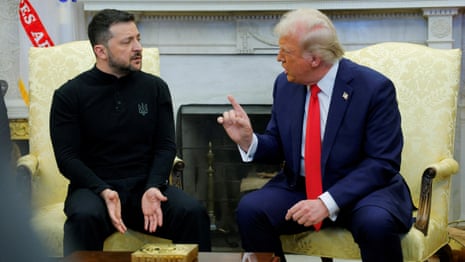
So what actually happened in the White House in February-March 2025, and how did the community react?
To understand where Trump's position comes from, we need to look back a little.
However, according to him, negotiations with the Ukrainian leadership are ineffective: ‘Zelenskyy has been participating in negotiations for three years and nothing has changed, he has no trump cards.’ These statements were the first signs of Trump's anti-Ukrainian policy.
In February, Donald Trump made a series of controversial statements about Zelenskyy, calling him a ‘dictator without elections.’ Trump criticised Zelenskyy for refusing to hold elections during martial law and claimed that the Ukrainian leader's approval rating had allegedly fallen to 4%. However, according to the Kyiv International Institute of Sociology, Zelenskyy's approval rating at the time was 57%, which the US president was probably unaware of.
Trump also accused Zelensky of misusing American aid and claimed that Ukraine was ‘manipulating’ the US, forcing it to spend significant funds on the war with Russia. He claimed that half of the funds provided to Ukraine had disappeared without a trace.
These statements caused a wide resonance in the international community. Many world leaders and media outlets condemned Trump's words, emphasising their groundlessness and danger. In particular, the British newspaper The Guardian described Trump's statements as ‘a compilation of the biggest “hits” of Russian disinformation over the past three years.’
After the first negotiations, the situation instantly became the focus of global media attention. The New York Post ran a cover story titled ‘This is a dictator,’ pointing to Putin, and columnist Douglas Murray published ‘10 truths about the Russian-Ukrainian war.’ Some of these truths were as follows:
- Putin started the war.
- Putin is a dictator.
- Zelensky won the election legitimately.
- Russia wants to absorb Ukraine.
- Ukrainians are fighting for their independence.
- Ukrainians and Russians are two separate peoples.
Trump, on the other hand, has repeatedly stated in his speeches that ‘Biden and Zelensky said the wrong things’ and that ‘Russia could have been so easily dissuaded from attacking.’ According to him, Zelenskyy's participation in the negotiations only complicates the process, and he would prefer that Zelenskyy not participate at all.
In parallel with the political negotiations, another important battle has flared up – an economic agreement on mineral resources.
According to preliminary versions of the agreement, the US demanded access to Ukraine's rare earth resources. However, according to CNN, NV and Politico, the new version of the agreement was much tougher. It stipulated that the US would receive 100% ownership of the future investment fund, and Ukraine would have to give more than it had spent on defence itself.
President Trump insisted that this agreement should be a source of support for Ukraine, but for Zelenskyy, the terms are too burdensome, as the agreement does not provide adequate security guarantees. ‘Security guarantees are what unite us with our partners,’ Zelenskyy says, ‘and I will not agree to a deal that will have 10 generations of Ukrainians paying back the debt.’
Donald Trump, who has always boasted about his negotiating skills, was on the verge of concluding a deal that, according to him, could bring the United States ‘350 billion dollars.’ However, Volodymyr Zelenskyy effectively rebuffed Trump by refusing to sign the agreement until the United States provided real security guarantees.At the same time, American diplomats continued to hold meetings with their Russian counterparts in Saudi Arabia, and Russian Deputy Foreign Minister Sergei Ryabkov announced a new meeting in late February or early March. According to White House officials, negotiations with Russia were more successful than those with Ukraine. Trump stated, ‘I had very good negotiations with Putin, but not so good with Zelenskyy.’
New threats also emerged in the economic sphere. For example, Reuters reported on the possibility of Ukraine being disconnected from the Starlink satellite communication system if the agreement on mineral resources was not signed. However, Elon Musk has already denied these rumours, stating that ‘Reuters is lying’. According to the Ukrainian military, including Senior Lieutenant of the Armed Forces of Ukraine with the call sign ‘Aleks’ and Head of the Centre for Countering Disinformation of the National Security and Defence Council of Ukraine and Lieutenant of the Armed Forces of Ukraine Andriy Kovalenko, alternative means of communication are being actively implemented. Polish Minister of Digital Affairs Krzysztof Gawkowski also stood up for Ukraine, stating that Poland pays a subscription fee for Starlink's work in Ukraine and that he ‘cannot imagine that anyone could decide to terminate a business contract for a commercial service to which Poland is a party.’The main topic of the meeting was the conclusion of an agreement on mineral extraction, which was intended to promote cooperation between the United States and Ukraine in the energy and industrial sectors. Trump insisted that the agreement was ‘very fair’ and would be a step forward for Ukraine's economic recovery, as well as opening up new opportunities for investment.
The President of Ukraine, in turn, stressed the need for security guarantees, emphasising that ‘Putin has violated the ceasefire 25 times’ and showing photos of Ukrainian soldiers who had returned from Russian captivity, as Trump is reportedly empathetic to such photos, and also brought a belt from the legendary boxer Usyk, as Trump has always been a boxing fan.
Video source: https://t.me/novynylive/141266
Zelenskyy stated that if Trump could bring peace, he would be compared to George Washington. Trump stated, ‘I am in the middle, I am for Ukraine and for Russia. I want this to be resolved. Europe and NATO must take action, I am also committed to the Alliance.’
However, the meeting at the White House quickly turned into an arena of emotional disputes. Trump and US Vice President Jay D. Vance repeatedly emphasised Ukraine's dependence on American support – ‘we gave you $350 billion, military equipment, without us this war would have ended in two weeks.’
Zelenskyy responded by saying that ‘Putin promised us three days, now I'm hearing two weeks.’
Trump repeatedly stated that ‘you don't have any cards.’
Zelenskyy replied, ‘I didn't come here to play cards.’
He called for real security guarantees, stressing that negotiations must be honest and that the compromise Trump called for must be fair in order to protect the Ukrainian people. Trump accused the Ukrainian leader of not thanking the US (which turned out to be untrue) and said that Zelensky could not demand anything more than what Trump himself was offering. At the end of the dispute, Trump described it as ‘a great show.’
According to Reuters, Fox News, BBC and other agencies, the negotiations were tense, and the press conference that was supposed to take place after the meeting was cancelled. Some media outlets also reported that ‘Zelenskyy was kicked out’ and that he tried to ‘reset the situation, but the US did not accept him.’
After the meeting and Zelenskyy's departure from the White House, Trump said that Zelenskyy was not ready for peace talks and could return when he was ready, while Zelenskyy thanked America for the reception.
Zelenskyy leaves the White House early after a dispute. Video source: https://t.me/RBC_ua_news/132604
Later, Trump cancelled the signing of the mineral resources agreement, as reported by Reuters, citing a White House representative.
The US Department of Energy announced the termination of support for Ukraine in restoring its energy system, and the Pentagon announced the suspension of cyber operations against Russia.
US government officials, including Secretary of State Marco Rubio and Treasury Secretary Scott Bessent, expressed their gratitude to Trump for ‘defending the interests of the American people.’
Amid the controversy, there have also been reports of changes in social media behaviour: users report that YouTube has suddenly started working without a VPN in Russia.
There is speculation online that Trump tried to publicly humiliate Zelenskyy and provoke him into making harsh statements in order to find a reason to end military support. This is evidenced by the rather childish behaviour of Trump and JD Vance.
When Zelensky asked what would happen if Putin violated the agreement again, Trump began to grimace. ‘What if, what if...’ he said, without giving any answers.
Vance also repeatedly emphasised that Zelenskyy ‘showed disrespect to the American people’ by not wearing a business suit to the meeting. Zelenskyy responded, ‘I will wear a suit when the war is over.’
Despite attempts by Trump and Vance to portray Zelenskyy in a negative light to the world, they only humiliated themselves. European countries immediately began to express their support for Ukraine. In particular, Germany, France, the Netherlands, Poland, the Czech Republic, Spain, Sweden, Norway, Lithuania, Georgia, Moldova and the EU.
Americans themselves are also expressing their support for Zelenskyy. In Times Square, New York, a campaign is underway to support Zelensky and condemn Trump's actions. In Manhattan, protesters are gathering around the Tesla dealership, chanting ‘Zelenskyy is a hero!’ and holding signs reading ‘Send Musk back to space,’ ‘No Nazis in New York,’ and other slogans against Musk and Trump.
On 2 March, an emergency summit began in London dedicated to the war in Ukraine and further steps to support it.
The EU countries, the UK, Turkey, as well as NATO and EU leaders are participating in it. The Baltic countries expressed their dissatisfaction with not being invited.
On 4 March, it became known that Trump had stopped military support for Ukraine.
This is despite the fact that just a day earlier, Trump said that there were no talks about stopping supplies yet.
A White House source told NBC News, and I quote: "The president has made it clear that he is focused on peace. We need our partners to be committed to that goal as well. We will pause and review our assistance to make sure it is conducive to a resolution."
Another source told Fox News that ‘this is not a permanent halt to aid, it is a pause.’
Reuters reported that all arms deliveries stopped around 3 a.m.
Not only did US arms deliveries stop, but so did those that were already in other countries on their way to Ukraine.
Reuters launched another broadcast from Maidan Nezalezhnosti (Independence Square) on this subject, which, however, was quickly terminated because it had not been agreed with the Security Service of Ukraine and the Kyiv City Military Administration.
The Times reported that by suspending military aid, the White House would force Zelenskyy to abandon security guarantees under the mineral resources agreement.
Support from the European Union has also stalled. According to Politico, the EU has suspended the development of a new €20 billion military aid package for Kyiv due to pro-Russian Hungary.
According to various estimates, Ukraine will be able to hold out for six months without Western weapons.
Elon Musk called on Zelenskyy to leave Ukraine.
Trump also continued his alliance with Russia. According to Bloomberg, he asked Putin to mediate between the US and Iran in nuclear talks, and Putin agreed.
However, this did not force the Ukrainian government to back down.
According to the BBC, Zelenskyy has no intention of apologising to Trump or expressing regret for what happened in the Oval Office.
And although the Ukrainian government has confirmed that it is ready to sign an agreement on mineral resources, this does not mean that the government is ready to accept any conditions for the sake of Trump.
Since the full text was not published, at that time there were only guesses about the content of the document.
This was the biggest crisis in American-Ukrainian relations in February-March 2025. It was largely caused by the arrival of Trumpists in the government, who made no secret of their sympathies for Russia. Thus, the Trumpists' populist promises of a ‘swifter and unconditional end to the Russian-Ukrainian war’ turned into lies, yet more populism and flirting with Russia, to such an extent that it sometimes becomes unclear whose ally the US really is — Russia and the CSTO, or Ukraine, the EU and NATO. US aid to Ukraine remains, in fact, suspended or at a minimum level, while the agreement on mineral resources was signed on more equitable terms. Closer to 2026, the negotiation process between Russia, the US and Ukraine was more advanced.

Comments
Post a Comment